




Crude spikes as markets reprice duration and disruption risk
Oil prices surged on Monday as investors recalibrated expectations for how long the conflict involving the United States, Israel, and Iran could last. The shift followed remarks from President Donald Trump indicating the confrontation may extend beyond a few weeks, a message that raised the probability of broader energy market disruption and pushed traders to demand a higher risk premium.
U.S. crude oil gained more than 7%, while Brent, the global benchmark, rose about 9%. For U.S. crude, the move translated into an increase of nearly $6 per barrel. The jump came after a year that was already marked by steady upward pressure, with oil prices up 17% so far this year even before the weekend escalation, driven in part by Trump’s intensified rhetoric toward Iran and an increase in U.S. sanctions in recent months.
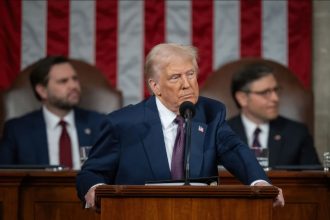
Speaking at the White House, Trump said the U.S. would continue large scale strikes in Iran and suggested the timeline could be longer than initially projected. “Whatever the time is, it’s OK,” he said. “Right from the beginning, we projected four to five weeks, but we have capability to go far longer than that. We’ll do it.” Traders interpreted the comments as a signal that a short, contained episode is no longer the base case.
Gasoline prices begin to move, with inflation risks debated
The impact has started to show up at U.S. gas stations. GasBuddy data indicated the national average retail gasoline price rose 5 cents since Sunday to $2.99 per gallon. Patrick De Haan, an analyst at GasBuddy, said on social media that the national average could touch $3 per gallon as higher wholesale costs appear at more locations.
Higher crude typically passes through quickly. Retail gasoline prices tend to rise about 2.5 cents for every $1 move in crude, suggesting additional increases are possible if oil continues to climb. The move comes at a sensitive moment for households that have faced elevated living costs for years, and it has reopened questions about whether energy driven inflation could complicate economic policy.
Jamie Dimon, chief executive of JPMorgan Chase, said on Monday that a brief shock would likely lift gas prices modestly without causing a major inflation surge. He added that a longer conflict would pose a different risk profile. His remarks reflected a broader split in market thinking: duration matters as much as magnitude because persistent energy costs can filter into transport, manufacturing, and consumer expectations.
Hormuz chokepoint and shipping pullbacks become central focus
While Iran’s oil output is estimated to account for less than 5% of global production and much of that supply goes to China because of U.S. sanctions, the country holds outsized influence over the Strait of Hormuz. The passage is critical for more than 20% of the world’s daily oil demand, making it a key vulnerability for global supply chains.
Industry analysts have framed restrictions in the Strait as one of the most severe possible scenarios for the oil market. Longtime analyst Andy Lipow said a closure or meaningful limitation could rapidly destabilize prices and availability. Shipping behavior suggests rising caution. Traffic through the Strait has largely slowed as tanker and container operators seek to avoid being pulled into the conflict zone.
Over the weekend, at least six major cargo shipping companies said they were halting or diverting vessels that had been scheduled to transit the waterway. Such changes can tighten near term supply even without a formal blockade by creating delays, insurance hurdles, and rerouting costs that ripple through delivery schedules.
Luis Costa, Citigroup’s global head of emerging markets strategy, said in a Sunday night note that geopolitical oil shocks often fade quickly, but warned that a longer episode could keep volatility elevated for an extended period. The market is now trying to judge whether the current disruption is a short spike or the start of a more persistent repricing of energy risk.
Global markets wobble as investors pivot to safe havens
Equities opened sharply lower on Monday but recovered from early losses in U.S. trading. The S&P 500 finished roughly flat, the Nasdaq Composite ended up about 0.3%, and the Dow fell 73 points. The Russell 2000, a measure of smaller companies, closed higher by 0.8%.
Losses were more pronounced overseas. The Stoxx 600 ended down 1.7%, Germany’s DAX dropped 2.5%, France’s benchmark fell 2.2%, and Italy’s slipped 2%. Japan’s Nikkei closed down 1.4% in overnight trade.
Safe haven demand rose alongside the energy shock. The U.S. Dollar Index gained 1%, and gold futures climbed 2%, adding more than $100. Jorge León, head of geopolitical analysis at Rystad Energy, said the scale of Iran’s retaliation surprised markets and represented a very different environment from what traders had anticipated.
Supply responses are also emerging. Eight oil producing countries in OPEC+ said on Sunday they plan to increase output by more than 200,000 barrels per day starting next month, a move aimed at easing market stress. Analysts at JPMorgan said the direction of oil prices will depend on four variables: how much supply is disrupted, how long any disruption persists, whether other sources can be mobilized quickly, and what events follow next.
Energy risks extend beyond crude. Lipow said Qatar is the world’s second largest exporter of liquefied natural gas behind the United States, and he warned that LNG tanker diversions could lift natural gas prices, especially in Europe. On Monday, Qatar’s state run energy company said it would pause LNG production due to military attacks on operating facilities, without providing a restart timeline. U.S. natural gas prices rose about 5% Monday morning, while European gas futures surged about 45% after the announcement.