






Weekend escalation reshapes risk assumptions
Risk assets opened the week under pressure after a weekend of military escalation involving the United States, Israel, and Iran raised the prospect of longer lasting geopolitical and energy market stress. Stock futures fell in early trading as investors weighed the potential for additional conflict, higher commodity prices, and renewed volatility across global markets.
The U.S. and Israel carried out overnight strikes on Saturday that killed Iran’s leader, Supreme Leader Ayatollah Ali Khamenei, in an operation identified as Operation Epic Fury. Reports said hundreds of Iranian citizens were killed in the strikes. The mission also resulted in the deaths of multiple American service members and triggered retaliatory hits by Iran, according to the briefing.
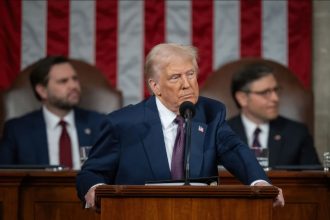
President Donald Trump said he would avenge the deaths of three U.S. service members described as the first known American casualties tied to the mission. The U.S. also said three fighter jets crashed in what appeared to be a friendly fire incident. Trump told CNBC’s Joe Kernen that the military operations were ahead of schedule and warned the conflict could last up to four weeks, adding it could lead to more American deaths.
Beyond the direct military developments, the weekend events disrupted travel and logistics. A large portion of Middle East airspace was closed, leaving thousands of flights canceled and travelers stranded across multiple regions, adding another channel of uncertainty for business travel and supply chains.
Markets pivot to oil, gold, and volatility signals
Traders focused quickly on energy prices as a potential transmission mechanism into inflation and growth expectations. U.S. crude oil prices surged in early trading, and investors assessed whether the situation could evolve into a 1970s style energy shock. The risk is not limited to the headline price move, but also to secondary effects on transportation costs, consumer sentiment, and central bank policy expectations if higher energy costs persist.
Safe haven demand increased alongside the selloff in futures. Gold futures advanced as investors sought protection from geopolitical uncertainty, while the so called fear gauge rose to its highest levels of 2026. In premarket trading, energy and defense stocks rallied, consistent with positioning for higher energy prices and increased defense demand in a heightened security environment.
The market entered the session with weakened momentum. The S and P 500 and Nasdaq Composite posted their worst months in nearly a year in February, while the Dow Jones Industrial Average managed a gain for the month, extending its longest winning streak since 2018. Friday closed with a loss for both the day and the week, leaving investors more sensitive to negative catalysts and headline risk.
Berkshire results highlight insurance pressure in Buffett transition
Corporate focus also turned to Berkshire Hathaway’s latest quarter, described as its final quarter with Warren Buffett as chief executive. Operating earnings fell nearly 30%, weighed heavily by a 54% decline in profits from the insurance underwriting business. The numbers underscored how underwriting results can swing and how insurance performance can dominate overall profitability in a given period.
Even with weaker operating earnings, analysts and investors responded positively to new chief executive Greg Abel and his first annual shareholder letter. Market commentary highlighted approval of Abel’s commitment to the company’s value focused approach and his articulation of capital allocation priorities. Abel was not described as planning major operational changes at the Omaha based conglomerate, but he struck a different tone than Buffett used in prior letters, signaling a new voice while maintaining the core philosophy.
AI procurement dispute and consumer signals add crosscurrents
Policy and technology headlines added another layer of complexity. The briefing said Trump forced U.S. agencies to stop using Anthropic technology after the startup pushed back against the Pentagon’s usage demands. Within hours, Sam Altman, chief executive of competitor OpenAI, said his company reached a deal with the Department of Defense.
Altman said OpenAI applied the same red lines on guardrails as Anthropic and that the Defense Department accepted those restrictions. The episode raised questions about why the government would accept such requirements from OpenAI but not Anthropic, a discrepancy that could matter for how AI vendors evaluate federal contracting risk and policy consistency.
Anthropic gained a consumer tailwind over the weekend. Its Claude AI assistant app climbed to the top of Apple’s list of free apps, suggesting the company may be benefiting in public perception after its pushback to the Pentagon, even as it faces curtailed federal usage.
Consumer spending patterns surfaced in a separate earnings contrast in the fitness industry. Life Time and Planet Fitness both reported solid growth, but differences in their results were presented as evidence of a K shaped economy. Life Time’s luxury members are paying higher dues and spending on add ons such as personal training and spa visits. Planet Fitness, positioned as a value chain, offered a softer outlook that raised concerns about how much more price sensitive consumers can stretch their budgets.
Investors also have a busy earnings and data calendar ahead. The week includes results from Target, Best Buy, Versant Media, and CrowdStrike on Tuesday, earnings from Abercrombie and Fitch and an ADP jobs report on Wednesday, and reports from Kroger, Costco, Gap, and Olaplex on Thursday, followed by the nonfarm payrolls report on Friday.