






A family name collides with new ingredient labels
A dispute over a seasonal candy has pulled a broader inflation era business tactic back into the spotlight. Brad Reese, a grandson of H.B. Reese, says some products sold under the Reese’s name no longer match the classic combination that made the brand famous. His complaint centers on what he argues is a quiet downgrade in ingredients that keeps prices palatable while cutting costs, an approach that has been described as skimpflation.
The flashpoint came as Valentine’s Day approached, when Reese bought a bag of Reese’s Mini Hearts and said the candies were made with “chocolate candy” and “peanut butter creme” rather than the traditional pairing of milk chocolate and peanut butter. He told The Associated Press the product was unfit to eat and said he threw the bag away. What made the criticism resonate was not only his intensity but also his connection to the brand’s origin story.
H.B. Reese created Reese’s Peanut Butter Cups in 1928, and the Reese family sold the company to The Hershey Company in 1963. The name remains on the wrappers, and Brad Reese has leaned into that identity, appearing publicly in Reese’s branded clothing and presenting himself as a custodian of what he calls the brand’s integrity.
An open letter escalates into a public pressure campaign
On Valentine’s Day, Reese published an open letter addressed to a Hershey executive that amplified the issue beyond a single bag of candy. In the letter, he argued that the brand was built on a concrete product identity and that it is now being altered by formulation changes that swap milk chocolate for compound coatings and peanut butter for peanut-butter-style creams across multiple items.
He has expanded the push into a broader personal campaign. His website now positions him as defending Reese’s brand integrity and includes an image of an orange cap bearing the slogan “Make Reese’s Great Again.” The effort has created a form of consumer facing reputational risk for Hershey, because it frames reformulation as a cost cutting tactic rather than a product innovation.
The debate uses a label that originated in the Planet Money newsletter, which coined skimpflation to describe companies preserving sticker prices by reducing quality. The dynamic differs from shrinkflation, where quantity shrinks, and from standard inflation, where prices rise outright.
Cost shocks in cocoa and tariffs shaped product decisions
The pressures behind chocolate reformulations have been tied to supply disruptions and cost volatility. About 70% of cocoa production comes from West Africa, where damaging rainfall and extreme drought have disrupted output. The instability helped push cocoa prices to record highs in late 2024, with financial speculation also cited as a contributing factor.
Trade policy added another layer. The Trump administration imposed high tariffs on cocoa-producing nations, affecting U.S. chocolate manufacturers including Hershey. Over the last year, those pressures eased. In November, the administration exempted cocoa from high tariffs, and supply conditions in West Africa were described as partly improved. Since May 2025, cocoa prices have fallen almost 80%.
Even with easing costs, product lines do not pivot instantly. Candy production and marketing operate on long lead times, so items on shelves can reflect ingredient and packaging choices made months or years earlier when input prices were more extreme.
Label rules, Hershey’s response, and the information gap
Regulation plays a central role in how these ingredient shifts show up to consumers. Federal standards tightly define what can be sold as milk chocolate, including a requirement for at least 10% chocolate liquor, a paste made from ground cocoa beans. When formulations fall short, packaging cannot use the regulated term.
An investigation by Claire Brown at The New York Times in October reported that several products across major brands, including Hershey items such as Almond Joy, Mr. Goodbar, and Rolo, replaced milk chocolate wording with “chocolate candy.” The change signals a different formulation while remaining legal under labeling rules.
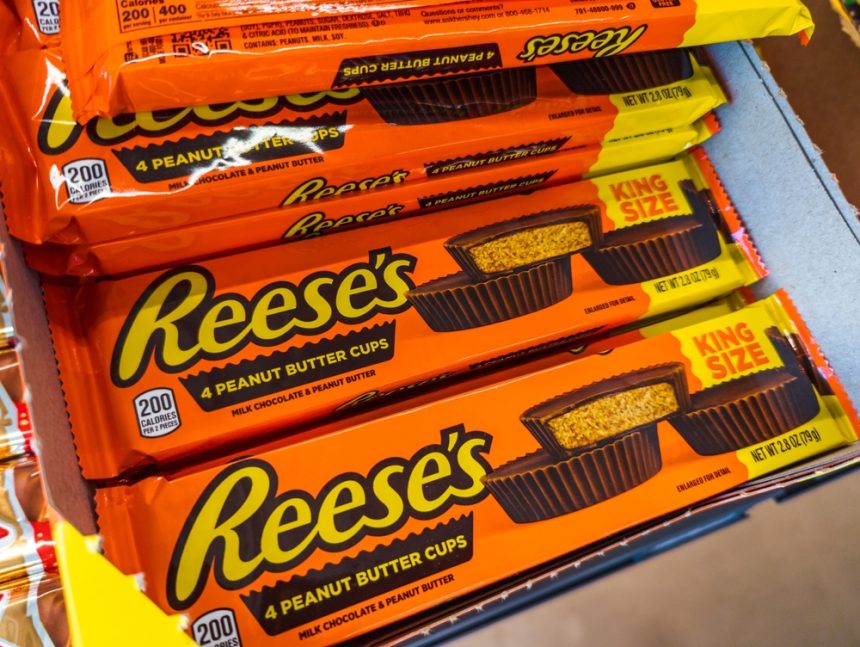
Hershey responded to questions with a statement that its iconic Reese’s Peanut Butter Cups are still made the same way and still begin with roasting fresh peanuts to create its peanut butter before combining it with milk chocolate. The company also said recipe adjustments across the broader Reese’s lineup can be part of creating new shapes, sizes, and product variations, and it argued that any updates are reflected on packaging ingredient information, which it described as the most accurate source for consumers.
The contrast between the statement and the broader product range suggests that while the core cups may remain unchanged, other items carrying the Reese’s brand can differ in whether they meet the federal definition of milk chocolate or peanut butter. That creates a potential mismatch between consumer expectation based on brand association and what a specific product actually contains.
Skimpflation debate reaches beyond candy to policy questions
Analysts say skimpflation is difficult to measure because it is about quality rather than quantity. Lindsay Owens, executive director of the Groundwork Collaborative, said her 2024 work found shrinkflation could account for as much as 10% of inflation in certain categories, including paper goods and some snacks, but she noted that skimpflation is harder to quantify systematically.
Owens argued that ingredient downgrades can carry broader implications, particularly when cheaper formulations mean more processed food. The concept also links to asymmetric information, where buyers may not fully understand what they are purchasing. Existing laws, including the Fair Packaging and Labeling Act, require ingredient disclosure and limit how certain terms can be used, but subtle label shifts can still be easy to miss.
Owens said authorities should consider whether labeling practices need updating to improve clarity. At the same time, the Hershey-Reese dispute shows another pathway for accountability: public scrutiny driven by journalists, influencers, and vocal consumers who highlight changes that may otherwise remain buried in small print.