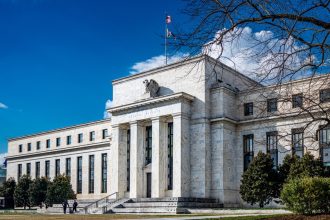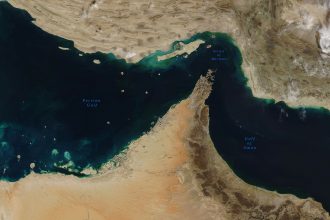





Chicago Federal Reserve President Austan Goolsbee warned that the war involving Iran is creating a particularly difficult economic threat for the United States by pushing inflation higher while also risking weaker growth. His comments highlight the kind of policy dilemma central bankers most want to avoid: a situation in which prices rise at the same time that consumers, businesses and the labor market begin to lose momentum.
The concern is not just that oil has become more expensive. It is that this new energy shock is arriving before earlier price pressures have fully faded. Goolsbee noted that inflation linked to tariffs had been expected to ease over time, yet now a fresh surge in oil prices is hitting before that process is complete. That overlap increases the risk that inflation will become more deeply embedded across the economy rather than remaining a temporary spike.
For the Federal Reserve, that creates an especially uncomfortable environment. Normally, a weakening economy would argue for lower interest rates, while rising inflation would argue for caution or tighter policy. When both forces appear at once, the usual policy playbook becomes far less useful.
Goolsbee says there is no easy policy script
One of the most important parts of Goolsbee’s message was his admission that there is no obvious “cookbook” for how the Fed should respond if this scenario worsens. That is a striking formulation because it captures how uncertain the current moment has become. Policymakers are no longer debating a simple question of whether inflation is cooling or growth is holding up. They are now confronting the possibility that both trends could deteriorate in different ways at the same time.
In that setting, the central bank cannot rely on familiar patterns. If it leans too far toward supporting growth, it risks allowing inflation to become more entrenched. If it stays too focused on price stability, it could end up tightening conditions into an economy that is already losing confidence and slowing.
That tension is exactly why Goolsbee described the situation as deeply uncomfortable. The Fed may soon be forced to choose between risks that are both serious and difficult to measure in real time.
High oil could hit prices and confidence together
Goolsbee made clear that the longer oil prices remain elevated, the greater the danger that the shock spreads through the broader economy. Higher energy costs do not stop with gasoline or heating bills. They feed into transportation, manufacturing, distribution and household budgets, eventually putting upward pressure on a wider range of prices.
At the same time, those higher costs can weaken the economy by draining purchasing power from consumers. That is especially important in the United States, where household spending remains the main engine of growth. If families begin to feel squeezed enough to cut back or start hoarding cash out of fear, the damage could move quickly from inflation into demand destruction.
That is the mechanism behind Goolsbee’s warning about a possible stagflationary outcome. It is not only a story about rising prices. It is a story about how rising prices can undermine confidence and spending badly enough to pull growth down with them.
The labor market is stable, but not reassuring
Goolsbee said the job market is currently “stable but not great,” a phrase that suggests the labor backdrop is no longer strong enough to offer much comfort if the oil shock persists. A labor market that is merely steady can quickly become more fragile if business costs rise and consumer demand softens.
That makes the current environment more precarious than a headline unemployment number might imply. If firms begin to face weaker sales while also paying more for energy and inputs, hiring could slow further and layoffs could start to rise. That would intensify the feedback loop the Fed fears: weaker jobs, weaker confidence, weaker spending and still-elevated prices.
In other words, the labor market may not yet be breaking, but it may not be strong enough to absorb a prolonged inflation shock without visible damage.
Markets now expect no rate cuts this year
The Federal Reserve left short-term interest rates unchanged in the 3.5% to 3.75% range last month and had previously signaled that another cut later in the year could be possible if inflation continued moving back toward the 2% target. Since then, however, the outlook has become more difficult.
Financial markets are now betting that the Fed will keep rates on hold through the end of the year. That shift reflects the growing belief that policymakers will not feel comfortable easing while oil prices are pushing new inflation risks into the system. Even if growth slows, the central bank may feel constrained by the danger of appearing too relaxed in the face of another inflation wave.
Goolsbee’s comments reinforce that uncertainty. He did not argue clearly for higher rates or lower ones. Instead, he emphasized how hard the choice could become if the economy starts moving in a stagflationary direction. That may be the clearest signal of all. Right now, the Fed’s main problem is not simply deciding what to do next. It is that the path ahead is becoming harder to read with confidence.