




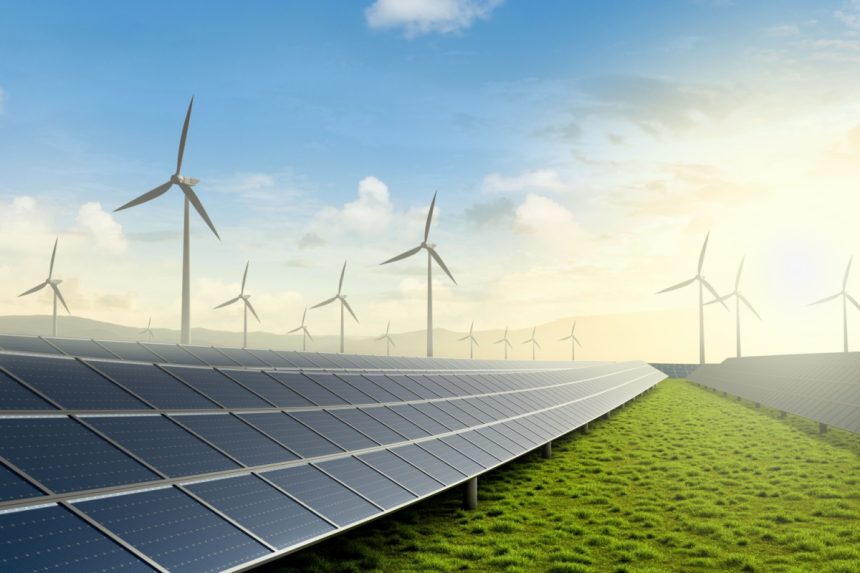

Amazon said it remains one of the world’s leading corporate buyers of carbon-free power, and that its Amazon carbon-free energy investments now span more than 700 projects globally and exceed 40 gigawatts of capacity. According to the company, that is enough electricity to power more than 12.1 million U.S. homes.
The update was published by Kara Hurst, Amazon’s Chief Sustainability Officer, who described the company’s energy strategy as part of a broader push to meet rising grid demand while supporting long-term reliability and cost stability. Amazon said its portfolio includes solar, wind, nuclear, and battery storage, and emphasized that these projects add new supply to the public grid rather than serving only internal operations.
For a financial news audience, the scale of Amazon’s carbon-free energy investments matters because large corporate procurement programs can influence project financing, utility planning, and regional electricity markets. As data center growth and AI-related computing increase power demand, long-term power agreements from major companies can become a key source of funding certainty for developers and utilities.
Amazon also presented the strategy as a community infrastructure play, saying new carbon-free generation can help modernize local energy systems and contribute to more stable electricity costs for households and businesses.
Grid Upgrades and Local Economic Effects
Amazon said its carbon-free energy strategy is designed to support the broader grid, not just company facilities. As an example, it cited work in Mississippi tied to its data center investment, where the company collaborated with utility provider Entergy.
According to Amazon, that collaboration enabled the addition of 650 megawatts of new renewable energy to the grid, with capacity equivalent to powering more than 150,000 homes once operational. Amazon also said Entergy is using investments from Amazon and other large customers to support its US$300 million “Superpower Mississippi” grid reliability campaign, which aims to reduce outage frequency and duration for average customers by about 50% without adding to residential ratepayers’ costs.
The company said its broader portfolio of Amazon carbon-free energy investments now stretches across 28 countries. It includes four nuclear power agreements, 11 utility-scale battery storage projects, more than 300 utility-scale wind and solar projects, over 300 onsite solar installations, and six offshore wind farms in Europe.
Amazon further said these projects are producing local employment benefits in addition to new energy supply. The company described thousands of construction roles and hundreds of permanent jobs associated with development and operations, while also arguing that corporate-backed projects can improve grid resilience and support the infrastructure needed for advanced digital services.
Nuclear and Storage Move to the Center
A central theme in the latest update is Amazon’s expansion into next-generation nuclear power. The company said it is investing billions of dollars in small modular reactors (SMRs), describing nuclear energy as a source of steady, carbon-free electricity that can operate around the clock.
In Washington state, Amazon said its first agreement with Energy Northwest will support the development of four advanced SMRs with an initial capacity of 320 megawatts, expandable to 960 megawatts. At full expansion, Amazon said the project could power more than 770,000 U.S. homes, with operations expected in the early 2030s.
Amazon also said it is investing US$500 million in X-energy to support more than 5 gigawatts of new U.S. nuclear capacity by 2039, which the company estimates could power roughly 4 million homes. It added that these SMR projects are expected to create more than 1,000 construction jobs and over 100 permanent positions in local communities.
Battery storage is another core area within Amazon’s carbon-free energy investments. The company said it has funded 11 utility-scale battery storage projects to help address intermittency from solar and wind generation. At the Baldy Mesa project in California, Amazon said it uses AI-powered machine learning software that analyzes up to 33 billion data points annually to determine when to store and release power based on grid conditions. The company said that the approach can improve grid stability during high-demand periods, including heat waves.
Efficiency Metrics Support Growth and Cost Control
Alongside generation and storage, Amazon highlighted operational efficiency as a major part of its energy and sustainability strategy. The company said it is focused on reducing both water and electricity intensity across data centers, fulfillment facilities, and logistics operations.
For water use in data centers, Amazon said it tracks performance through Water Usage Effectiveness (WUE) and aims to achieve a “water positive” outcome by 2030. The company reported a 40% improvement in data center water-use efficiency since 2021 and said that many facilities use water-based cooling for less than 5% of the year. Amazon also reported a global WUE of 0.15 L/kWh in 2024, which it said marked a 17% improvement from 2023.
On power efficiency, Amazon said its data centers achieved a global Power Usage Effectiveness (PUE) of 1.15 in 2024. The company said performance exceeded average levels in both public cloud and on-premises enterprise data center environments, indicating lower electricity consumption for the same computing output.
Amazon also said it is reducing energy waste through AI-assisted cooling systems, robotics in fulfillment centers, and a large electric delivery fleet. For investors, the broader message is that Amazon’s carbon-free energy investments are being paired with efficiency gains and infrastructure planning, which may help the company manage rising electricity demand while supporting long-duration growth in data, cloud, and AI operations.