



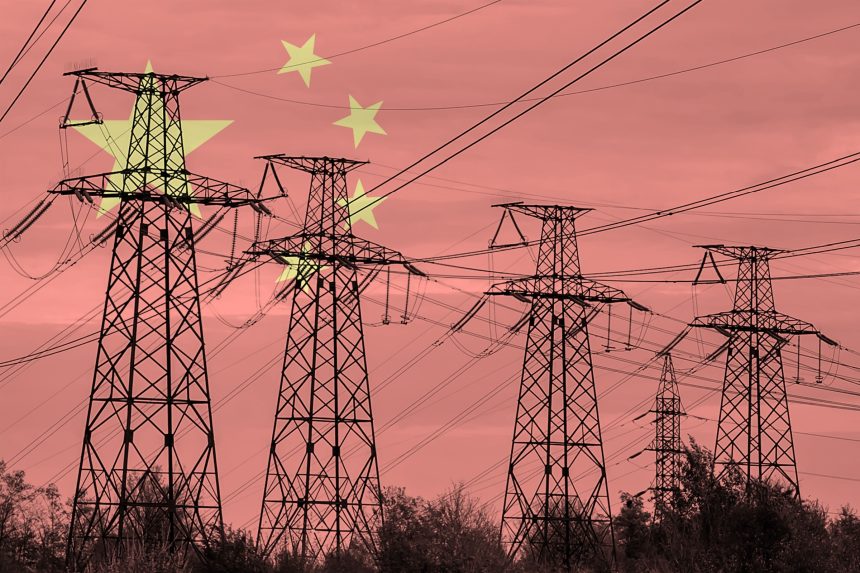

China’s push to strengthen its power system is entering a new phase, with batteries and grid infrastructure moving to the center of energy planning. China’s battery grid strategy is designed to make the country less vulnerable to imported fuel shocks while supporting more wind and solar generation. Recent reporting has described this as part of a broader effort to build resilience into the world’s largest electricity system.
That strategy matters because China still depends heavily on imported oil and gas in key parts of its economy. At the same time, Beijing has spent years expanding domestic electricity generation, long-distance transmission, and storage. Bloomberg reporting, syndicated by Yahoo Finance, said this buildout is giving President Xi Jinping a larger buffer against external energy disruptions, especially after the Middle East conflict pushed energy security back to the top of many governments’ agendas.
The underlying logic is straightforward. A more electrified economy can rely more on domestic power sources and less on imported fuels. Batteries then help smooth the mismatch between renewable generation and power demand. The result is not full energy independence, but a more shock-resistant system that can absorb volatility better than one built mainly around continuous fossil fuel imports.
Batteries Become a Core Grid Asset
Battery storage is becoming one of the main tools in that system. China’s battery makers are not only serving electric vehicle demand. They are also expanding technologies aimed at large-scale power storage, including lithium-ion systems and new sodium-ion designs. Reuters reported in March that Chinese manufacturers are betting heavily on sodium-ion batteries to reduce dependence on more constrained materials such as lithium, cobalt, and nickel.
That matters for grid economics because energy storage does different work from generation. Batteries can store power when renewable energy output is high and release it when demand rises or when weather conditions change. In a system with more solar and wind, that flexibility becomes increasingly valuable. Reuters reported that firms including CATL, BYD, and HiNa Battery Technology are pushing sodium-ion batteries into both transport and energy storage applications, with policy support expected to encourage wider utility adoption from 2025 to 2027.
China’s interest in sodium also signals a broader industrial calculation. If storage becomes a strategic layer of the electricity system, controlling multiple battery chemistries can reduce future supply risks and lower long-term costs. Reuters said sodium-ion batteries still face disadvantages in energy density, but they are seen as attractive for storage and some commercial applications because sodium is abundant and potentially cheaper.
Transmission Spending Turns Renewables Into Security Assets
Storage alone is not enough. China has also spent heavily on transmission infrastructure, so electricity generated far from coastal demand centers can move across the country at scale. Bloomberg’s reporting said state-owned grid operators have become some of China’s biggest bond issuers as investment in grid expansion accelerated. That financing boom reflects the scale of infrastructure needed to integrate more renewables and reduce import exposure.
This is where the China battery grid strategy becomes more than an industrial policy story. It turns renewable energy into a security asset. Wind and solar generation are useful only if they can be connected, moved, balanced, and dispatched reliably. Grid spending makes that possible, while batteries help stabilize the system when supply and demand move out of sync. Together, they allow China to convert clean energy deployment into broader economic resilience.
That resilience is increasingly relevant for global investors because it can influence industrial competitiveness. A country with a more stable power system may be better positioned for energy-intensive sectors, data centers, and advanced manufacturing. It may also be less exposed to the inflationary effects of fuel disruptions that still hit more import-dependent economies.
Strategic Strength Still Comes With Limits
The strategy, however, does not eliminate all vulnerabilities. China still relies on foreign sources for some fuels and remains deeply tied to global supply chains. Batteries themselves also depend on complex manufacturing inputs and evolving policy support. Reuters reported that even in the United States, where battery storage installations are rising sharply, supply chains remain heavily exposed to Chinese upstream components, including battery cells that make up a large share of total system cost.
That comparison matters because it shows how China’s strength is layered. It is not only about building a large domestic market for storage and grid equipment. It also remains central to the manufacturing base that other countries depend on as they expand their own electricity systems. Reuters said U.S. battery storage installations rose 30% in 2025 to 58 GWh, with another 60 GWh projected for 2026, yet upstream dependence on China remains significant.
For markets, the broader takeaway is that China’s energy strategy is becoming more integrated. Batteries, grids, and renewables are no longer separate policy areas. They are increasingly part of a single system designed to improve reliability, support growth, and reduce exposure to external fuel shocks. That makes the China battery grid strategy not just a domestic infrastructure story, but a central theme in the global competition over energy security and industrial power.