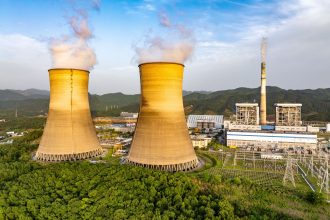







A Tennessee fusion testing facility is moving forward through a new partnership involving Oak Ridge National Laboratory, the University of Tennessee, and Type One Energy. Yahoo’s report, citing local coverage, said the project will anchor a fusion development campus at the Tennessee Valley Authority’s Bull Run Energy Complex in Clinton, Tennessee.
The partners plan to build a high-heat-flux facility, also known as an HHF. It will test how materials perform under the extreme conditions inside fusion systems. That work is important because plasma-facing components endure the most severe stress in fusion devices.
ORNL and UT described the project as a national-scale asset for fusion development. The facility is expected to support both public and private teams working on pilot plant designs. Researchers will use the site to qualify and validate materials before commercial deployment.
For energy investors, the project matters beyond research headlines. It strengthens the infrastructure needed for fusion commercialization, which depends on engineering reliability rather than plasma physics alone. It also adds another public-private investment signal in the U.S. fusion ecosystem.
Why This Facility Matters for Fusion Commercialization
Fusion is often described as a long-term clean energy option because it can produce power without direct carbon emissions. The U.S. Department of Energy says fusion combines light nuclei under extreme conditions, releasing heat that could later be converted into electricity. DOE also notes that major scientific and engineering challenges still remain.
Those engineering challenges include materials durability, heat management, and component lifetime. The planned Tennessee fusion testing facility addresses exactly that problem set. It is designed to expose materials to high heat loads similar to those expected in future fusion machines.
UT and ORNL said the site will be only the second facility of its kind in the United States. They also said it will be the only domestic facility using pressurized helium gas cooling, which many U.S. fusion concepts prefer. That makes the project unusually relevant for companies developing next-generation reactor hardware.
The institutions also framed the project as part of a broader East Tennessee nuclear and fusion cluster. That regional concentration can lower development friction by linking labs, universities, utilities, and private firms. In practical terms, it may improve timelines for testing, hiring, and supply coordination.
Bull Run Site, Timeline, and Technical Scope
The facility will be located at TVA’s Bull Run Energy Complex, a former coal plant site being repositioned for advanced energy uses. Local and institutional reports said the Bull Run location will host the fusion campus effort. That reuse angle also reflects a broader industry trend toward repurposing legacy power infrastructure.
According to UT, the project team is targeting a steady-state heat load of more than 10 megawatts per square meter on component surfaces. The partners said that the level is comparable to the heat flux inside some rocket engines. They plan to achieve the testing conditions using electron beam technology.
UT also said the project is slated for completion by the end of 2027. TVA is already conditioning the site, while the partners finalize design and procurement. That timeline places the work in the near-term development window, not a distant concept stage.
The project will draw support from multiple sources, including DOE’s Fusion Energy Sciences program, Type One Energy, and the State of Tennessee. That funding mix is important because fusion development usually requires long timelines and shared risk. Public-private cost-sharing often determines whether enabling infrastructure is built.
Market Implications for Energy and Infrastructure Investors
The Tennessee fusion testing facility does not mean commercial fusion power is imminent. However, it does represent progress in a critical bottleneck area for future plants. Materials testing and validation are essential before large-scale fusion projects can attract broader infrastructure capital.
This matters for financial markets because fusion stories often emphasize breakthroughs in reactor design. Investors also need to track the less visible enabling systems that support commercialization. Testing platforms, component standards, and qualification capacity can shape which companies scale first.
The East Tennessee project also strengthens the U.S. domestic fusion supply and research base. ORNL, UT, TVA, and Type One Energy are building a pipeline that connects science, engineering, and utility infrastructure. That model may become more common if fusion funding continues to expand.
For now, the key takeaway is execution. Investors and industry observers will watch milestones on design completion, procurement, and site assembly through 2027. If the facility opens on schedule, it could become a strategic asset for U.S. fusion developers.